Feeding your Puppy
Young puppies should be fed 3 times a day. Depending on go-home weight, a puppy will be eating 1⁄2 – 3⁄4 cup of food at each feeding. Soak in some warm water about 15 minutes before feeding. Over the next couple weeks, soak it less and less. By 10 weeks it does not need to be soaked, but still add 1⁄2 cup warm water to the dry before feeding. DO NOT free feed. Increase food amount as he gets older but do not let him get fat. Leave a bowl of clean water out at all times.
Large-breed puppies need slow, sustained growth to help prevent orthopedic problems like hip dysplasia and cruciate tears. An overweight body condition is an important risk factor in
Developmental Orthopedic Disease, and feeding for fast growth increases that risk. Raise your pup on a diet designed for large breed puppies and stick with that until 12 months. If you wish to add “toppers” to the food, restrict that amount to more than 5-10% of daily ration, and stick to quality foods like meat, egg, cottage cheese. Do not add calcium/mineral supplements, because good foods are properly balanced in that regard. Supplementing with fish/salmon oil and probiotics is fine if you wish.
I will not force a buyer by contract to feed a certain food. There are breeders who require the buyer to purchase a specific food and or supplements, even canceling any health guarantee if you don’t. Just be aware these are quite profitable for the breeders, they get a percentage of every product you buy, every time. The most common of these product lines are Lifes Abundance and Nu-Vet.
Current evidence suggests that the recent “outbreak” of dilated cardiomyopathy (DCM) in dogs may be linked to food. DCM is a disease in which the heart does not beat strongly
enough to keep an animal healthy.
The common link that investigators have observed is “grain-free” diets that use lentils and other legumes (peas) as the “base ingredient.” Most nutritionists recommend using the WSAVA guidelines for selection of commercial diets.
At this point no diets manufactured by the major pet food manufacturers (Hills, Purina, Royal Canin), have been associated with current cases of diet-associated cardiomyopathy.
Interestingly, While allergies to grains can develop, less than 1% of dogs and cats in the general population are sensitive to grains. Allergies to animal-based proteins are much more common than grains.
Recommended Foods
Grain-inclusive foods which meet or exceed WSAVA Guidelines.
These companies include Purina, Royal Canin, Eukanuba, Iams and Hills. I personally use Purina Pro Plan or ONE products, or Royal Canin Golden Retriever formulas.
If you prefer a fresh, whole food diet, I recommend JustFoodForDogs, which is the only fresh food that does major research, feeding and digestibility trials and has a Nutrition Board of specialists that formulate the food. It is properly balanced and made in the USA.
Exercise for Young Dogs
Understanding Puppy growth
The first concept to understand when it comes to puppy exercise is “growth plates.” Growth plates are soft areas that sit at the ends of the long bones in puppies and young dogs. They contain rapidly dividing cells that allow bones to become longer until the end of puberty.
Growth plates gradually thin as hormonal changes approaching puberty signal the growth plates to close. In puppies, this closure is normally completed by approximately 18 months old.
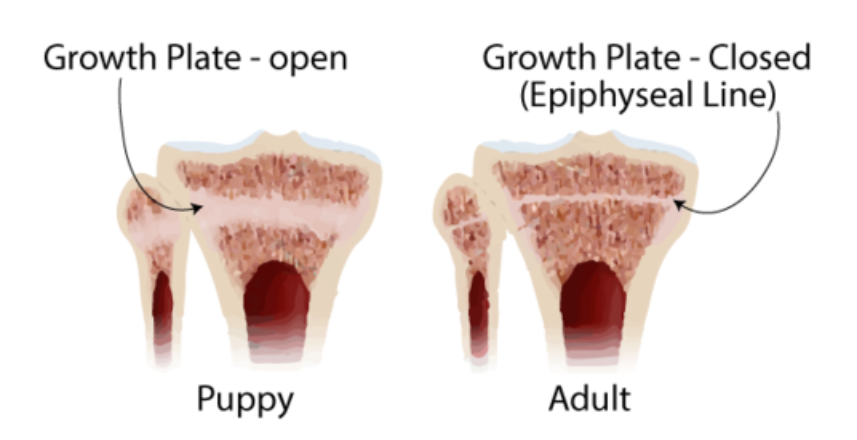
Until the growth plates close, they’re soft and vulnerable to injury.
After sexual maturity, the growth plates calcify and the rapid cell division ends. The growth plate becomes a stable, inactive part of the bone, now known as an epiphyseal line.In addition to having soft growth plates at the end of long bones, a puppy’s bones in general are “softer.” Dogs, like people, don’t reach their maximum bone density until after puberty.
Guidelines for Puppy Exercises
When you get your puppy, PLEASE keep this image in mind. Their bones do not even touch yet. They plod around so cutely with big floppy paws because their joints are entirely made up of muscle, tendons and ligament with a skin covering. Nothing is fitting together tightly or has a true socket yet.
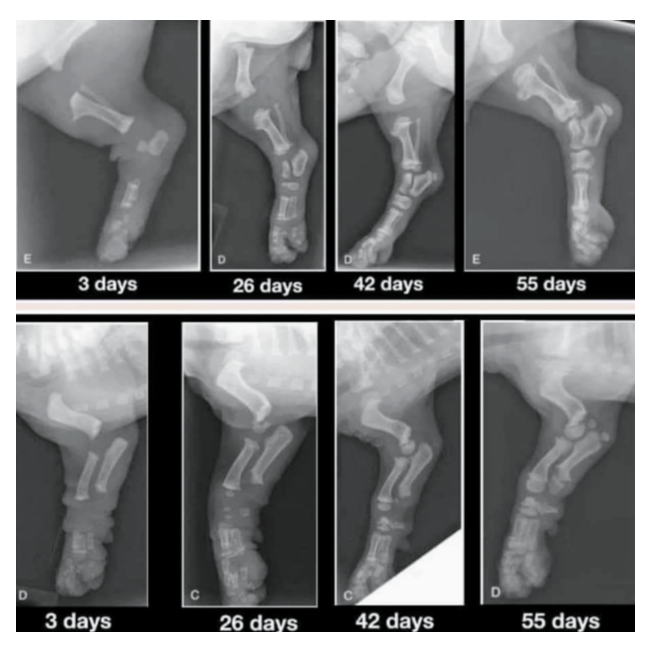
Self-directed play is an overriding rule for any puppy under 18 months old. The majority of his exercise should be free play, exploring, roaming around. If he shows any fatigue, flops down, refuses to walk, you should listen to him and let him rest.
Do not underestimate the value of a good digging session. Consider digging up a soft patch in a corner of your yard and burying “doggy treasures” in it – great natural exercise for your puppy!
‘No’ to repetition exercises
Probably the biggest cause of growth plate and soft tissue injury is repetitive exercise with a young puppy. So, until they are about 18 months old, long hikes and walks are out and lots of free-play sessions are in. Do NOT continually throw a ball or toy for your puppy to tire him out, especially on slick floors!
Sniffing and Strolling great for pups
While long hikes are out, strolling around in the backyard with you and short, rambling walks are great.
Let your puppy sniff, explore and take it at his own pace. You can use short training sessions in your walks to work on heeling/loose leash walking, but the majority of the time should be at your puppy’s own pace and discretion.
When you allow puppies to jump on and off beds, furniture, vehicles etc, let them scramble on slick floors or over exercise them, you are damaging their joints.
Stairs not great for young hips
A study of 500 Newfoundland, Labrador, and Leonberger puppies found that puppies who climbed flights of stairs daily before they were 3 months of age had an increased risk of developing hip dysplasia.
Spay/Neuter
We recommend waiting on spay/neuter until after 16 months for females (she should go through at least one heat), and 18-24 months for males.
Many studies have shown that early spay neutering is not in the best interest of your dog. It has been understandably pushed for many years by shelters and rescues to try to control pet overpopulation, but allowing dogs to keep their hormones is very important for proper growth and development.
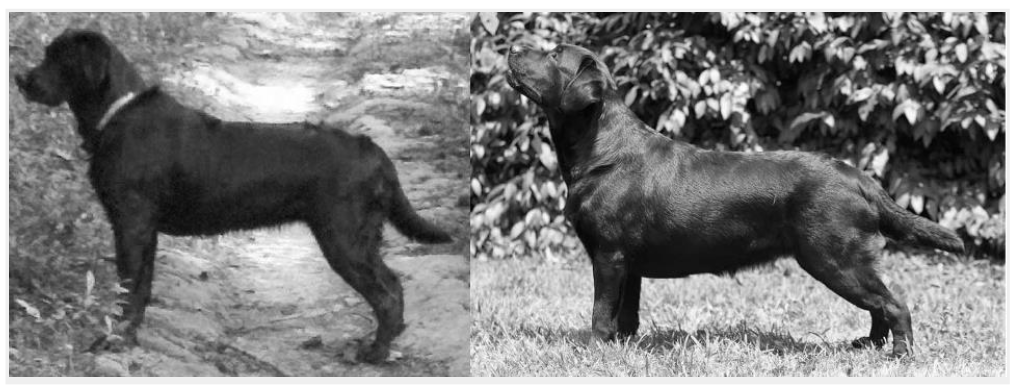
Early spay/neuter delays the closure of growth plates in the bones, due to removal of normal growth/sex hormones. When the growth plates stay open beyond the point they should normally close, the growth continues in the long bones, leading to a taller, more narrow and leggy dog. This change in conformation increases the risk of several orthopedic problems, including hip dysplasia, elbow dysplasia, luxating patellas, and torn cruciate ligaments.
Early spay/neuter also increases the risk of certain cancers, including hemangiosarcoma, osteosarcoma, and lymphoma. Increased risks are also evident for issues such as autoimmune disorders and behavioral problems.
Dogs altered early are more likely to develop hypothyroidism, and urinary incontinence in females.
From a visual perspective, early spay/neutered dogs will have longer legs, less muscle development and narrower heads and chests than non altered or later altered dogs. Imagine castrating a 12 year old boy, how would he look as an adult man?! Below is a photo comparing two female Labrador Retrievers from the same litter. The dog on the left was spayed early, it is easy to see the difference.
Vaccinations
Your pup will have had its first vaccination before going home.
Puppy vaccines are given as a series, they should be given 3-4 weeks apart, with the last given after 16 weeks. At 16 weeks, Rabies can be given also.
CORE vaccines are Distemper,Parvo, Adenovirus, Parainfluenza.
AAHA recommendations are to booster one year after the last of the puppy series, then no more often than once every 3 years. Do not vaccinate every year, it is unnecessary and compromises the immune system.
NONCORE vaccines are Leptospirosis, Bordetella, Lyme disease, Influenza.
These may be recommended by your Veterinarian, depending on geographical location, lifestyle and risk of exposure. Bordetella is often required if you plan on boarding your dog, it protects against Kennel Cough which is highly contagious and common in kennel situations with lots of dogs coming and going.
Socializing Your Puppy
From 7 weeks to 4 months of age, your puppy goes through a period that permanently shapes his future personality and how he will react to things in his environment as an adult. Gently exposing him to a wide variety of people, places and situations now has a huge impact on the rest of his, and your life!
The idea behind socialization is helping your puppy become acclimated to different types of sounds, sights and smells in a positive manner. Proper socialization can prevent a dog from being fearful of children, for example, or of riding in a car, and will help him develop into a happy, confident, well-mannered companion.
To a puppy, the whole world is new, strange and can be scary. Think of everything he encounters as an opportunity to make a positive association. Try to come up with as many different types of people, places, noises and textures as you can to expose your puppy to. Have him walk on different flooring… hardwood, tile, carpet, dirt, linoleum, over grates etc. Let him meet children, old people, people with hats, umbrellas, wearing sunglasses, using a cane or walker. Other (gentle) dogs of different sizes, cats. Make it positive. Use treats and praise so he associates what he is being exposed to and new things as fun. Try to avoid doing too much too fast and overwhelming him. Just be careful to avoid putting him on the ground at dog parks or other places where the puppy could contract parvo or distemper, until he has finished his last vaccine in the puppy series. You can carry him, get a puppy stroller, or put your pup in the cart and go through the pet store, or Home Depot.
Go to Puppy Classes! Once your puppy has had his first two vaccines, he can attend puppy classes. These classes not only help your puppy begin to understand commands, they also are fantastic for exposing him to other dogs and people. Trainers will mediate the classes so that all puppies and people are safe and happy. Puppy classes are generally for ages 10 weeks – 5 months and can be found at some pet stores and dog trainers.
 Goldway Ranch (Amantra) Goldens
You must be logged in to post a comment.